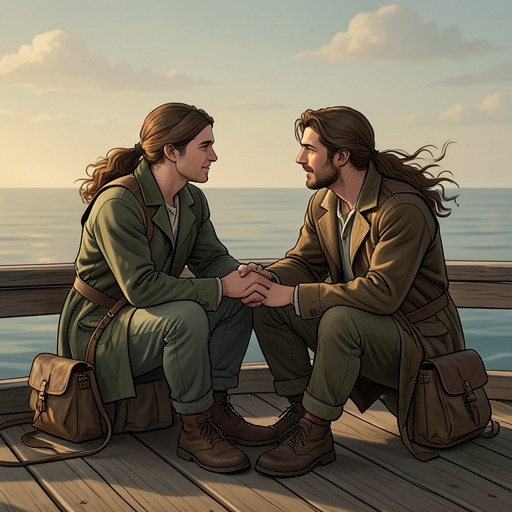
Captain Samaritano
Love in the Time of CholeraCaptain Samaritano is the seasoned commander of the New Fidelity, a man whose authority on the river rests alongside a fierce tenderness for its endangered animals. As the Magdalena’s forests and wildlife disappear and the river’s traffic becomes a means of escape, he helps transform a commercial voyage into a floating refuge for Florentino Ariza and Fermina Daza. His compassion gives Fermina a reason to trust him; his command makes their journey possible.
Identity and command on the river
The Captain works within the River Company of the Caribbean’s practical world of cargo, passengers, contracts, and navigation. He understands that ships do not move outside commercial obligations simply because their passengers wish it. Yet his command is not merely administrative: he knows the river’s hazards, the customs surrounding its vessels, and the ways official procedures can be bent or abused. When a journey without cargo or passengers becomes necessary, he recognizes both the risk and the opportunity, and insists that Florentino Ariza put his order in writing before he acts.
His professional authority has limits imposed by the company’s business commitments, but his personal decisions reveal a willingness to accept consequences. He has previously risked his navigator’s license by defying a paying hunter, and later agrees to use the cholera quarantine system to release the New Fidelity from its ordinary obligations. In both cases, command means taking responsibility for a choice rather than hiding behind rules.
Defense of the manatees
The Captain’s deepest moral commitment appears in his defense of the Magdalena’s manatees. He feels an almost maternal affection for them, imagining them as ladies condemned by extravagant love, and believes the legend that they are the animal kingdom’s only females without mates. His concern is not only sentimental: he opposes the customary practice of shooting at manatees from passing ships, despite laws that already prohibit it.
The limits of law become brutally clear when a North Carolina hunter, carrying valid papers, disobeys the Captain and kills a mother manatee with a Springfield rifle. Her calf wails beside the body. The Captain has the orphan brought aboard to care for it, while he leaves the hunter on the deserted bank beside the dead mother. Diplomatic protests lead to six months in prison and nearly cost him his navigator’s license. He emerges prepared to repeat the act if the need arises, making his defiance a deliberate commitment rather than an impulsive exception.
The rescued calf grows up in the rare-animal zoo at San Nicolás de las Barrancas and becomes the last of its kind seen along the river. The episode gives the Captain’s protective action a bitterly limited outcome: he saves one orphan, but cannot reverse the disappearance of the species. He says that whenever he passes the bank, he prays the hunter will board his ship so that he can abandon him there again. The repeated wish keeps the wound of the encounter present in the river’s ordinary passage.
Witness to ecological loss
The Captain’s account of the river’s changing condition supplies a material history of its decline. Fifty years of uncontrolled deforestation have consumed the forests that once crowded its banks; the riverboat boilers burned the colossal trees, while hunters and commercial demand helped eliminate its animals. Alligators were killed for their skins for tanneries in New Orleans. Parrots and monkeys vanished as their foliage disappeared, and the manatees were shot with armored bullets by sport hunters.
This devastation is not abstract background to the voyage. Florentino Ariza is surprised by how much the river has changed, and the Captain explains why navigation has become difficult: the great Magdalena that travelers carry in memory is no longer present in the same form. His remark that the river is all they have left sets the journey against a landscape already diminished by human use. The manatee story makes that loss intimate, while the wider account links it to deforestation, commercial traffic, and hunting.
Enabling the voyage under the cholera flag
The Captain helps turn Florentino Ariza’s hypothetical question into a concrete plan. Florentino asks whether a ship could travel without stopping, cargo, passengers, or port calls. The Captain explains that the River Company of the Caribbean has binding commitments, but that a case of cholera aboard would require quarantine: the vessel could hoist the yellow flag and sail in a state of emergency. He has used this procedure before because of cholera cases along the river, even when health officials later pressured doctors to certify the deaths as common dysentery.
He also knows that the yellow plague flag has been used for less honorable ends, including evading taxes, avoiding an unwanted passenger, or escaping inspections. That history makes the Captain’s consent consequential: the same procedure can serve evasion or provide the lovers with a way to continue together. After Florentino reaches for Fermina’s hand and asks to proceed, the Captain sees what the request means. He says that he commands the ship but Florentino commands them, and offers to leave at once if the order is written. Florentino signs it.
The crew transfers the little cargo they have taken aboard, tells the passengers that a mechanical failure has occurred, and sends them onward on another company’s vessel. At dawn, the New Fidelity departs without cargo or passengers, the yellow cholera flag waving from its mainmast. The Captain asks to stop at Puerto Nare to collect someone of his own: Zenaida Neves, an old friend he calls his wild woman, whom he picks up in one port and leaves in another. The private attachment he brings into the voyage parallels, without duplicating, the late-life love he is helping protect.
A trusted presence in the late voyage
Fermina Daza begins with no particular fondness for the Captain. His account of the orphaned manatee and the punishment he accepted for protecting it moves her, however, and from that morning he holds a privileged place in her heart. Her response matters to the voyage: the Captain becomes more than the officer who can manipulate the company’s rules. His tenderness establishes a basis for trust, and the narrative indicates that she will have many later occasions to feel that her judgment was right.
Near the voyage’s end, the Captain is troubled by the consequences of the cholera flag and cannot find a way out of the predicament it has created. Florentino listens, then looks toward the compass, the clear horizon, and the navigable waters and tells him to keep going back to La Dorada. Fermina recognizes in Florentino’s words the voice she knew from their earlier years, while the Captain is struck by his force of inspiration. The Captain’s final importance lies in his willingness to carry the decision forward: the river’s remaining route becomes the space in which the lovers can continue, and his ship, authority, and acquiescence sustain that possibility.